Friday, 19 August 2011

A slice of Lyme 3 - Being a little bit cagey


This is The Cage!

The Cage stands atop a small hill which rises away from Lyme Hall; the stately house at the heart of the Lyme Park Estate, now owned by the National Trust. The original Cage is thought to have been built around 1520 by Piers Legh V. However, this was demolished and the current building was constructed in 1736.

Primarily, the Cage was used as a hunting lodge, with huge banquets being served here after successful hunting parties. It has also served time as a prison for poachers, who were held here prior to being sent for trial. More recently, it was used as housing for park staff and then, in World War II, as a lookout point for the High Lane Home Guard.


As Sacristan and I sat in the doorway to The Cage, eating our sandwiches, we were being watched by a sharp-eyed onlooker!


And this observer was being very cagey; never coming too close, but remembering exactly where we had tossed every little crumb...


...and collecting it as soon as the coast was clear!


Thursday, 18 August 2011

Reservoirs

My personal challenge for this round of Miss Jenny Matlock's alphabe-Thursday is to post about a location within the borders of my own county of Derbyshire, UK, for each letter of the alphabet.


Look for the letter, to see where I am.


R is for reservoirs.

-------------------------------------------------------------------------------------------------------------

There are a number of significant reservoirs in and around Derbyshire, but with a combined capacity of 463,692 million litres, Howden, Derwent and Ladybower are the biggest of the lot. Situated in the Upper Derwent Valley, collectively, they are known as the Derwent Reservoirs.


These solid stone structures were first given Royal Assent in 1899, and the first two dams were constructed between 1901 and 1916.


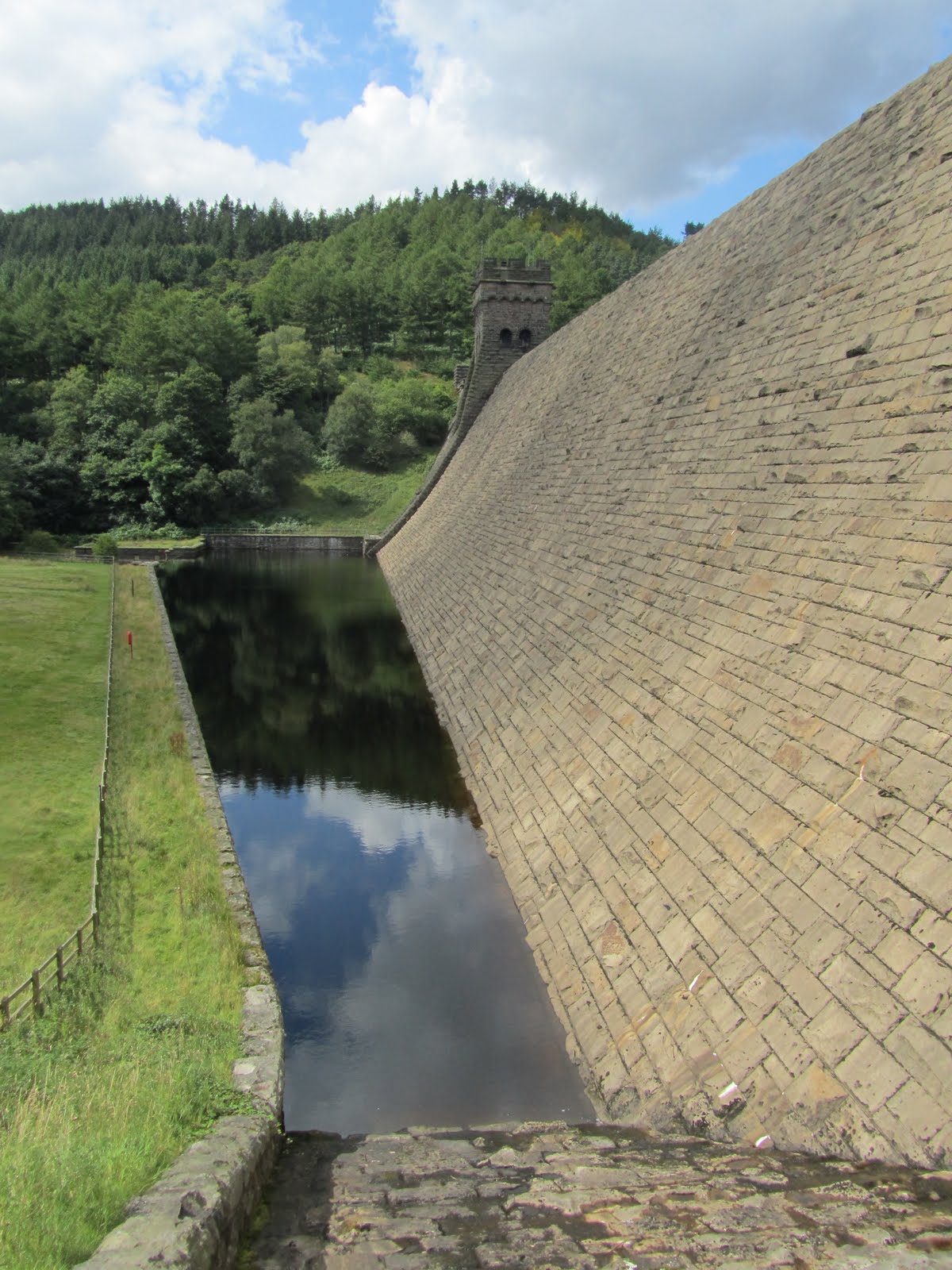
This is the Derwent Dam; the middle of the three. When the reservoir levels are high, water cascades over this wall into the channel below. No sign of water today, so I was curious to go beyond the dam to see the levels.


The reservoirs still haven't recovered from the dry Spring.


Further up the valley, at the top of Derwent Reservoir, is the wall of Howden Dam. This was the first of the three to be built, trapping the waters of the Derwent River in this narrow, steep-sided valley.


The side channel drops down a series of small falls to keep the river active. The water is orange with iron oxide from the peat moorlands.


The shores of all three reservoirs are planted with managed woodland; a mixture of deciduous and coniferous trees.


At its tip, Howden stretches into the high moors.


Up here is the Royal Oak, planted by King George VI on 25th September 1945.


The main purpose of the reservoirs is to provide water for North Derbyshire, Sheffield, Derby, Nottingham and Leicester, but lots of visitors also come here to enjoy the countryside. This is the Visitor Centre at Fairholmes; a fairly modest construction with a kiosk and a small shop, but which is also the centre for the rangers who care for this landscape.

This is the furthest north I have travelled for the A-Z. The landscape around here is very different from the villages further south; wilder and more remote. It has a character all of its own; wonderful, as long as you treat it with respect.

I hope you enjoyed the change of scenery.

Wednesday, 17 August 2011

A slice of Lyme 2 - Doing it in stile

Leaving the canal behind, a series of paths across the fields took us gradually closer to our intended lunchtime destination.


Notice the dog gate to the side of the stile.


I was intrigued by this fancy gate post! Why would someone stick a finial on top of a perfectly ordinary post?


In the distance, tantalising glimpses of the Cage were making my stomach rumble.


Entering into Lyme Park, we climbed yet another stile to amble through the woods (another doggy gate)...


...out the other end onto the drive...


...and straight up the hillside... 


...to the Cage.

Tuesday, 16 August 2011

A slice of Lyme 1 - Macclesfield canal

Back in early July, I went out for a walk with the Bradford HF Walking Group. A couple of weeks prior to the walk, Sacristan and I scouted out the route (as he was to be the walk leader for the day).

The photos I will be sharing over the next few days are an amalgum of the two times of walking the route.


The first section followed the old railway incline from Poynton out towards the Macclesfield Canal. It was easy walking up a very gentle gradient until a stile brought us out onto the towpath.


A few boats were active on the water.


This old Morris Minor Estate was parked up behind some moorings.


Beyond the bridge, there is a small marina.


But our route took us over the bridge and away to the fields.

Sunday, 14 August 2011

St Pancras


A week before we disappeared off on 'holiday', Mark travelled through London and had to wait on St Pancras station for a couple of hours. He spent the time experimenting with my Dad's old camera, trying to find some interesting compositions. He offered them for the blog and I was very happy to dedicate a post to his shots.


The curved sweep of the station frontage. There is so much detail in the architecture of this building!


Since becoming the International terminus for the Channel Tunnel trains, St Pancras has had something of a restoration and revamp. I love the arched roof. It lets in so much light.


The Olympic Rings are here in anticipation of the big event next summer.


Because it is now such a busy terminus, St Pancras has also sprouted a plethora of shops to entice the traveller to part from his hard earned money.


Statues represent the theme of the traveller. One wonders where this smart gentleman may be going...


...or how long it will be before this loving couple are reunited.


The plaque caught Mark's attention because of the named location. Butterley, in our home county of Derbyshire, is now the home to the Midland Railway Centre.

I hope you enjoyed Mark's collection. I must encourage him to offer more photos for future posts.


Thursday, 11 August 2011

Quarndon

My personal challenge for this round of Miss Jenny Matlock's alphabe-Thursday is to post about a location within the borders of my own county of Derbyshire, UK, for each letter of the alphabet.


Look for the letter, to see where I am.


Q is for Quarndon.

-------------------------------------------------------------------------------------------------------------

Quarndon is a village to the north of Derby; flowing almost directly out of the city suburb of Allestree. It has a population of around 900 and its name comes from the old English cwoern, meaning quern (a handmill for grinding corn) and dun, meaning a hill.


It has a mix of housing, but most tends to be quite high end and some properties are large!


The main street slopes gently allowing good views south towards Derby.


This terraced house was once the village pub.


Across the road is the Millennium sundial. To tell the time, stand with your heels on the line labelled with the correct month. Your shadow will show the time according to British Summer Time. (Subtract one hour to find Greenwich Mean Time).


The nearby post box is a GR; George VI, 1936 - 1952 (father to our current Queen).


Across the main street is the Parish Church of St Paul, which was built in 1874 at a cost of just over £4,000.


The four gargoyles at the base of the spire represent the four Gospel writers (Matthew - man, Mark - lion, Luke - ox and John - eagle). The skeleton clock was erected in 1897 to commemorate the diamond jubilee of Queen Victoria.


I love the weather vane atop the spire.


In front of the church is the village war memorial...


with its beautiful Celtic cross.


The Village Hall, at the top of the main street, has been variously known as the Parish Hall, the Institute and the Church Hall.


While, at the bottom of the hill is the 17th century Joiners Arms pub and, beyond that, a similarly aged drinking place; the village spring well.


Once a famous spa, the wall plaque claims that, in 1727, the Chaleybeate Well was visited by Daniel Defoe.

Staying on the theme of water, just outside the village is this unusual structure...


The Quarndon water tower stores a supply of water at an elevated height. The purpose of this is to increase water pressure in the local system.

When I took this photo, I had to include the speed limit sign. Ooops! :)

Quarndon is a popular place to live, but finding a house here is neither easy, not cheap. With the appropriate planing permission, one can always try constructing a place to live...


or maybe you would prefer to wait until a suitable property came on the market...


From the road, it doesn't look soooooo impressive, but this 5 bedroom, 4 reception room, 3 bathroom freehold property, complete with outbuildings, a coachouse and 1.68 acres of beautifully landscaped grounds, is currently for sale and will set you back a mere £1,450,000. Any takers?