Showing posts with label Ashbourne. Show all posts

Monday, 3 January 2011

Catherine Booth

Within the Ashbourne Memorial Gardens is this statue.


Catherine Booth was born in Ashbourne on 17th January 1829, daughter of a coachbuilder. From here, the family moved to Boston in Lincolnshire and later to Brixton, London. She was a comitted Christian with a strong sense of social justice and became a member of both the Band of Hope and the Temperence Society.

On 16th June 1855, she married William Booth, a Methodist minister and Catherine became a preacher in the Methodist Church at a time when such things invited heavy censure. She was brilliant and gained a reputation for being an exceptional speaker.

When the couple moved to the East End of London, they founded a Christian Mission which, over time, developed into the Salvation Army. Within the Army, women enjoyed equal status with men, working together in the fight against poverty and injustice.

Catherine organised Food for the Millions shops, where the poor could buy a meal for sixpence; exposed the practice of sweatshop labour for women and children, campaigning for improved working conditions and wages, and spoke out against the use of yellow phospheros on match heads becuase of the illness it caused to those applying it.

She died on 4th October 1890 after losing her personal battle with cancer; survived by her husband, eight children and a growing church, which flourishes and continues its work amongst the poor to this day.


Sunday, 2 January 2011

Memorial Gardens

This was Ashbourne on the Tuesday before Christmas. The children's play area is deserted.


The swings are stilled, the springs of the rockers are sprung and the slides devoid of "Wheeeee!".


The words of the carol, 'Earth stood hard as iron, Water like a stone' come to mind with new clarity. 

Through the hedge, the Ashbourne Memorial Gardens are quiet. Dedicated to those who died for their country, they are an oasis on the edge of the town, a peaceful place to walk, sit or just use as an alternative through-route into town.

During the annual two-week long Ashbourne Festival, events are held here; musical and visual, usually ending with the 'Picnic in the Park', which has free entertainment and is open to all.


Within the memorial Gardens is the bandstand. Opened in 1952, it is used regularly, including by the Ashbourne Town Band, which traces its history back to 1861. Not surprisingly, the band have been particularly busy for the past few weeks with a series of Remembrance Day and Christmas engagements, though mostly in church and village halls around the area.


There are many minor entrances to the park and gardens, but these are the main Memorial Gates, against which are laid the poppy wreaths each Remembrance Day. The plaques alongside the gates, list the names of the local soldiers who died in the world wars. There are many family names here which are still common in the town; names like Wibberley, Bunting, Dykes, Fearn.


Ironically, these gates are rarely open. Alternatives are no more than 50 metres in either direction, but I often wonder how many new visitors to the town arrive at this view of a potential place for a stroll or a picnic, and stand here having a discussion about how to get in!

Saturday, 1 January 2011

Cokayne


This not especially inspiring building, which now serves as the town library, was once Ashbourne Hall; home to the Cokayne family (yes, really).

It is believed that the Cokayne family were allied to William the Conqueror (1066 and all that) but they first settled in Ashbourne in the 12th Century and continued to live here until the Hall was eventually sold off by Sir Aston Cokayne in the 17th Century. Although Ashbourne was their primary residence, the family also owned land in other parts of Derbyshire; as well as in Warwickshire, Bedfordshire and Northamptonshire. They were very much examples of what would be known as 'Landed Gentry' and, as such, exerted a great deal of influence over all of the people living and working on their estates. In Ashbourne, their holdings were quite considerable and included all of what can be seen in the photo below, and more besides. The photo was taken from the top of the town park, on the playing fields just below Cokayne Avenue.


Now, this land is open to the public, and the playing fields see regular use by the local schools and sports teams. It is also the site of the annual Highland Gathering which takes place each July and has grown to become the largest event of its kind outside Scotland.

The mast on top of the hill is close to where my grandma lived many years ago. I remember playing in the field around the base of it as a child, fed up of the company of adults and allowed to roam free as long as I kept away from the main road at the bottom. (Sad that kids today don't have anywhere near the freedom which we enjoyed).

I also remember this house. It always struck me as odd that one house in a whole row would be 3 storey. I can only assumne that either the builder or architect who constructed the row, designed that particular house for himself. When I was about 8 or 9, I thought that this would be an extremely cool place to live, up there on the edge of the hill in the very tallest house. Although I grew out of the desire to live in that house, the desire to live high up with views has never faded and I doubt it ever will.

Friday, 31 December 2010

Equatorial Crafts

Yet another passageway into Ashbourne's lower market place, begins here, by the Millennium clock which was erected to celebrate the turn of the millennium (wow, is that REALLY eleven years ago?) and officially opened by the Mayor of Ashbourne on 17th March 2000.


Turn round the corner by Pet's Pad and follow the narrow, cobbled jitty down towards Victoria Square.


In Victoria Square, you can find Equatorial Crafts; one of many establishments which contribute to Ashbourne's status as a Fairtrade town. Set out over two floors, this shop is packed with crafts from Latin America; all sourced by the owner who makes frequent journeys out to trade with local suppliers. Here, you can buy clothes, bags, jewellery, embroidery and a range of other knick knacks; mostly brightly coloured, mostly well made and all very distinct in their ethnicity. If you're in the area, it's well worth a visit!

Thursday, 30 December 2010

Market Place


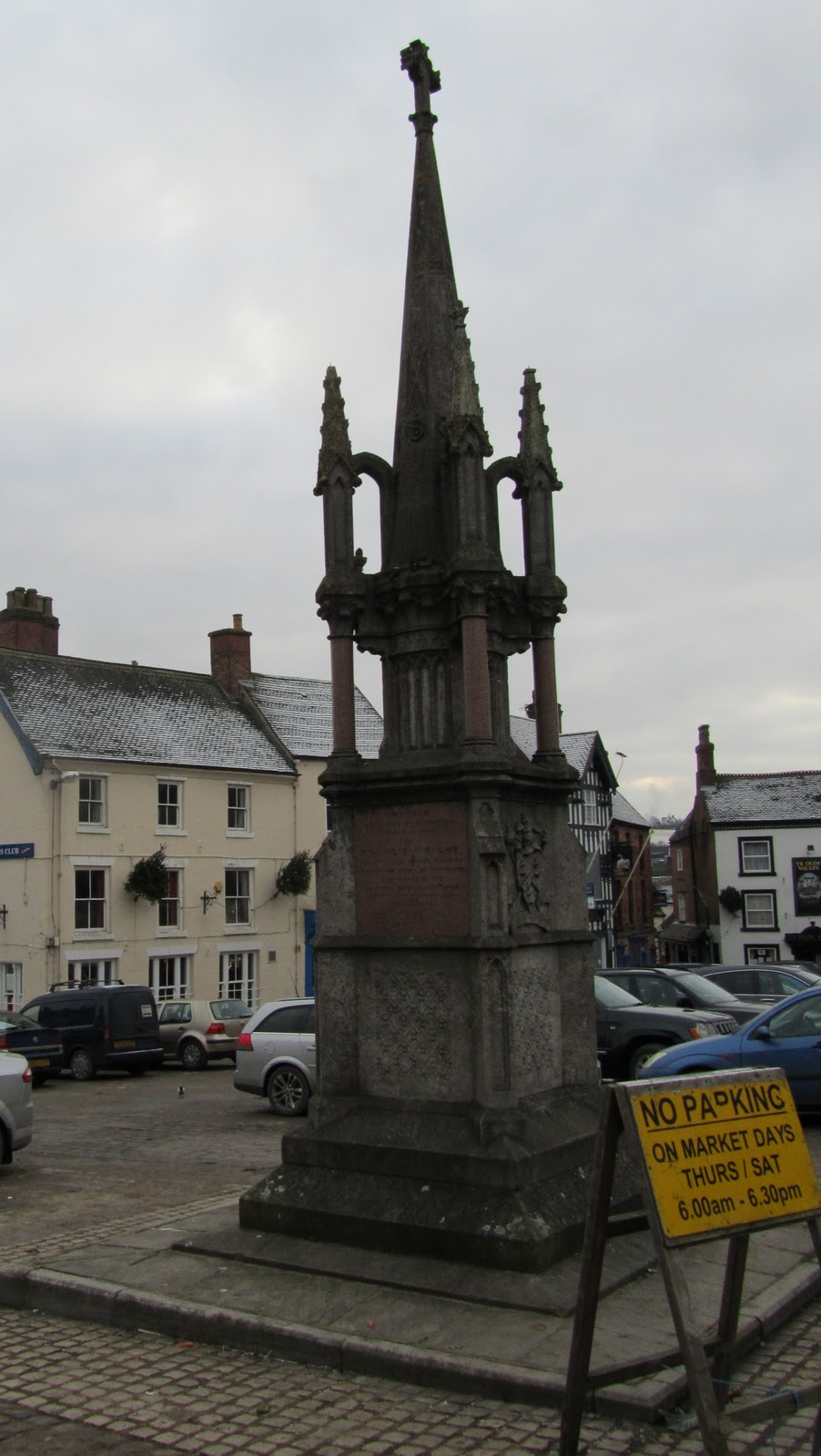
The market town of Ashbourne is in the Derbyshire Dales, very close to the border with Staffordshire. It was first granted a royal charter to hold markets in 1257 and held regular livestock markets, plus horse fairs three times a year and cheese fairs four times a year. Current market days are Thursdays and Saturdays, but livestock are no longer involved here. On market days, stall-holders set up in the early morning and sell throughout the day; food and drink, clothing, electrical and media, jewellery etc etc. During the rest of the week, this upper section of the market place serves as a car park.


At the top of the Market Place, is the Wright Memorial, erected in 1874 in memory of Francis Wright, a local industrialist who owned the ironworks at Butterley and lived in nearby Osmaston Manor. Although a benefactor to the town, Wright was not universally popular, due to his attempts to ban the annual Shrovetide football match, which survived him and is still the BIG event of the town's calendar!
Just in front of the Wright Memorial was the Bull Ring, which was used to tether the poor victim for the popular medieval sport of bull baiting. It was close to this spot that Bonnie Prince Charlie proclaimed his father, James, 'King of England' during the first Stuart rebellion of 1745. Unfortunately for the Bonnie Prince, his march on London was halted a mere 20 miles further south at Swarkestone and James never did claim the English throne. Ashbourne remains, however, the only place in England where a 'Pretender' to the throne has been proclaimed.


There has been a Christmas tree at the top of Ashbourne market place for as long as I can remember. As a child, travelling back through the town from my nanna's house, this was the part of the journey where I used to perk up and peer out of the car window, searching for the first glimpse of the brightly coloured lights. They were firmly switched off this afternoon though, waiting for darkness to descend.


Ye Old Vaults pub splits the market place into its two sections. This pub began life in around 1620 as a small timber framed building with the rather incongruous name of The Anatomical Horse and a skeleton of a horse as its sign. It was modernised in the late 19th Century, at which time it was given its present name. Maybe they figured that few people would want to drink in a pub which looked like it wanted to be a place for scientific experimentation.


From here, you can choose to go down the passage to the left (towards yet another pub - and mind the Peak Waste bins!)...


...or down the passage to the right (anyone for an ice cream?)


...to access the lower market place. This part of the market was The Shambles, where the animals were butchered and it was, for many years, known as Butcher's Row. Nowadays it goes by the much more regal name of Victoria Square and contains mainly 'independent' shops, an art gallery, the 'gas' lamp and a seating area.

The gas lamp dates back to the 1830s when a group of businessmen met to discuss the setting up of a gas company. Originally, the lamp was at the very bottom of the market place, but it was recently restored and moved to its current location. Now, it is powered by electricity. 


Stand here on a busy summer day, and there will be buskers entertaining the passers by, drinkers sitting outside the pub and people stopping for a natter. Today, at a grey -4.5 degrees C, everyone was much more interested in hurrying on towards warmth!

Thursday, 18 March 2010

Freedom of the Dales

It isn't everyday that we empty our school to line the streets of Ashbourne and wave Union flags at a regiment of Her Majesty's armed forces, but that is exactly what happened today.


Formed on 1st September 2007, when the Cheshire Regiment merged with the Staffordshire Regiment and the Worcestershire and Sherwood Foresters, the Mercian is a light infantry battalion which can be deployed anywhere in the world and has recently returned from a tour of duty in Helmand Province, Afghanistan.

The 2nd Battalion - The Mercian Regiment (Worcesters and Foresters) are mainly drawn from the English counties of Worcestershire, Nottinghamshire and Derbyshire - and Derby itself has a long association with the Foresters; their regimental headquarters having once been located at Normanton Barracks, within a couple of miles of where I grew up. I don't remember the soldiers, the barracks having closed in 1963, but I do remember the buildings, which remained until they were demolished in 1981.

In January of this year, the Mercian Regiment was granted the freedom of the Derbyshire Dales by the Derbyshire Dales District Council. One of the privileges of such an honour is that the regiment is now able to march with bayonets fixed, colours flying and band playing. There were no bayonets in evidence today, but the band played and the soldiers marched behind their colours, while the children waved the Union Flags and cheered them on.

Whatever our opinions of the rights and wrongs of war, whether in Afghanistan, Iraq or elsewhere around the world, our soldiers risk their lives to defend our country and I was happy to be there with the children to honour their bravery.

Wednesday, 27 January 2010

Tree Tunnels


The Cromford and High Peak Railway coped with the awkward Derbyshire countryside by running up a series of inclines, serviced by engine houses and winches to haul up the loaded wagons. In the first five miles of its route, it climbed a series of four inclines, rising over 1,000 feet.

In contrast, the London and North Western Railway Company who built the Tissington line selected to map or engineer a route level enough for a steam locomotive to pull carriages unaided. So, after emerging from the Ashbourne tunnel and passing over the Seven Arches viaduct, the route to Tissington is predominantly enclosed, running through a series of cuttings and over tree lined embankments.

In early summer, it can seem like walking through a tunnel of fresh green foliage with occasional glimpses of the landscape beyond.


(Best viewed large)


Tuesday, 26 January 2010

Benefitting from Beeching? : 'How the Trail Became'

The Peak District National Park (incidentally, the oldest in the world!) is divided into two distinct regions. The White Peak has a limestone base and is characterised by it's rivers, dales and rocky outcrops. Further north, the grit stone based Dark Peak is a land of wild moorlands and wide open spaces.

Traversing the White Peak, the Cromford and High Peak Railway was opened in 1831 as a link between the Cromford Canal at High Peak Junction and the Peak Forest Canal at Whaley Bridge. At the time it was a feat of engineering, being one of the first long distance routes (33 miles) and climbing to a height of 1,266 feet. In comparison, the highest working railway summit today is Ais Gill on the Settle-Carlisle line at 1,169 feet. C&HPR was built as an alternative to a canal and served to carry coal, stone and eventually cotton.
In 1899, it was joined by a second line, the Tissington Railway, which ran from Parsley Hay, 13 miles south to the market town of Ashbourne; from where there was a link to the main line at Rocester. At one time, milk from Derbyshire farms was transported down the Tissington line, onto the main rail network and from there to Finsbury Park in London.
Unfortunately, neither of these lines survived the Beeching axe, closing in stages through the 1960s. In 1971, however, the lines were given a new lease of life, being re-opened - in a joint venture between the Peak Park Planning Board and Derbyshire County Council - as trails for walkers, cyclists and horses. And so 'became' the Tissington and High Peak Trails.
Last May, I had the pleasure of walking a section of the Tissington Trail with a class of Y3 children. It rained (no surprise there then) and the back stragglers complained more and more with every step (awww! - we did a whole 3 miles!), but we had a great time, found loads of evidence of the trails original usage and, because it was a weekday, didn't even have to dodge many cyclists.


Almost the last section of our walk took us down the dip where once stood the Seven Arches. Sadly, the viaduct was demolished, but at least the new path took us right down to the level of the brook and the wooden bridge which crosses it.