Showing posts with label Peak District. Show all posts

Tuesday, 3 May 2011

At the end of the day

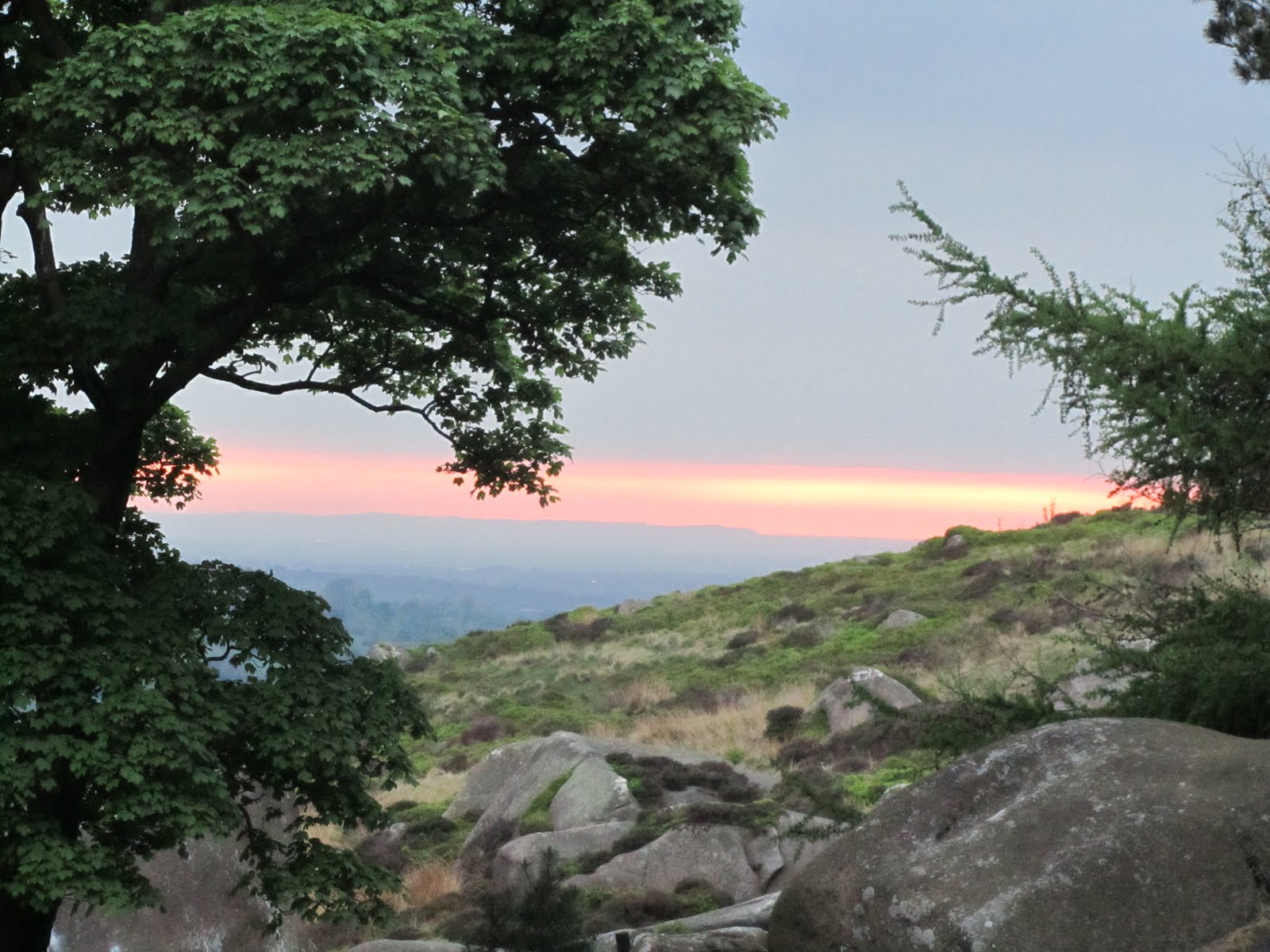
Believe it or not, these views were photographed from virtually the same spot (just below Rock Hall Cottage in The Roaches) within a couple of minutes of each other; just looking in different directions!


and closer.


And, turning slightly towards the west.


A lovely end to the day!

Monday, 2 May 2011

An outstanding mountaineer & a man of grit


Built in 1862, Rock Hall Cottage was originally the residence of the Roaches estate gamekeeper, and the last keeper to have lived here is thought to have raised a family of 12 children in this small dwelling. When the estate was sold off, the hut spent a few years in private ownership; lived in by a couple who desired peace, quiet and an escape from the negative aspects of daily modern life. However, the property began to fall into disrepair and in the 1990s a joint venture between the Peak Park Board and the British Mountaineering Council saw the it being converted into a climbing hut which can be hired out to any members of the BMC.


The renovation of the hut was spearheaded by the Don Whillans Memorial Fund. Don Whillans (18 May 1933 – 4 August 1985) was an English rock climber from Salford in Lancashire (now Greater Manchester); a working class lad who changed the nature of the sport from a pastime enjoyed by only the wealthy elite, to an activity loved by people of all backgrounds.

Climbing was a natural progression from his childhood pastime of walking the Pennines, and mountaineering followed on from his abilities as a climber; including a number of expeditions with, the better known, Chris Bonnington (with whom he was considered an equal in terms of climbing technical ability).

The Roaches was one of his favoured climbing spots and the route he particularly enjoyed was The Sloth; an overhang on the Upper Tier of the rocky outcrop, above and to the left of Rock Hall cottage. It was whilst climbing here that he met his wife, Audrey, who opened the hut in 2003.

It was in Rock Hall Cottage that Mark and his friends were staying. What a view to wake up to each day! 


Saturday, 30 April 2011

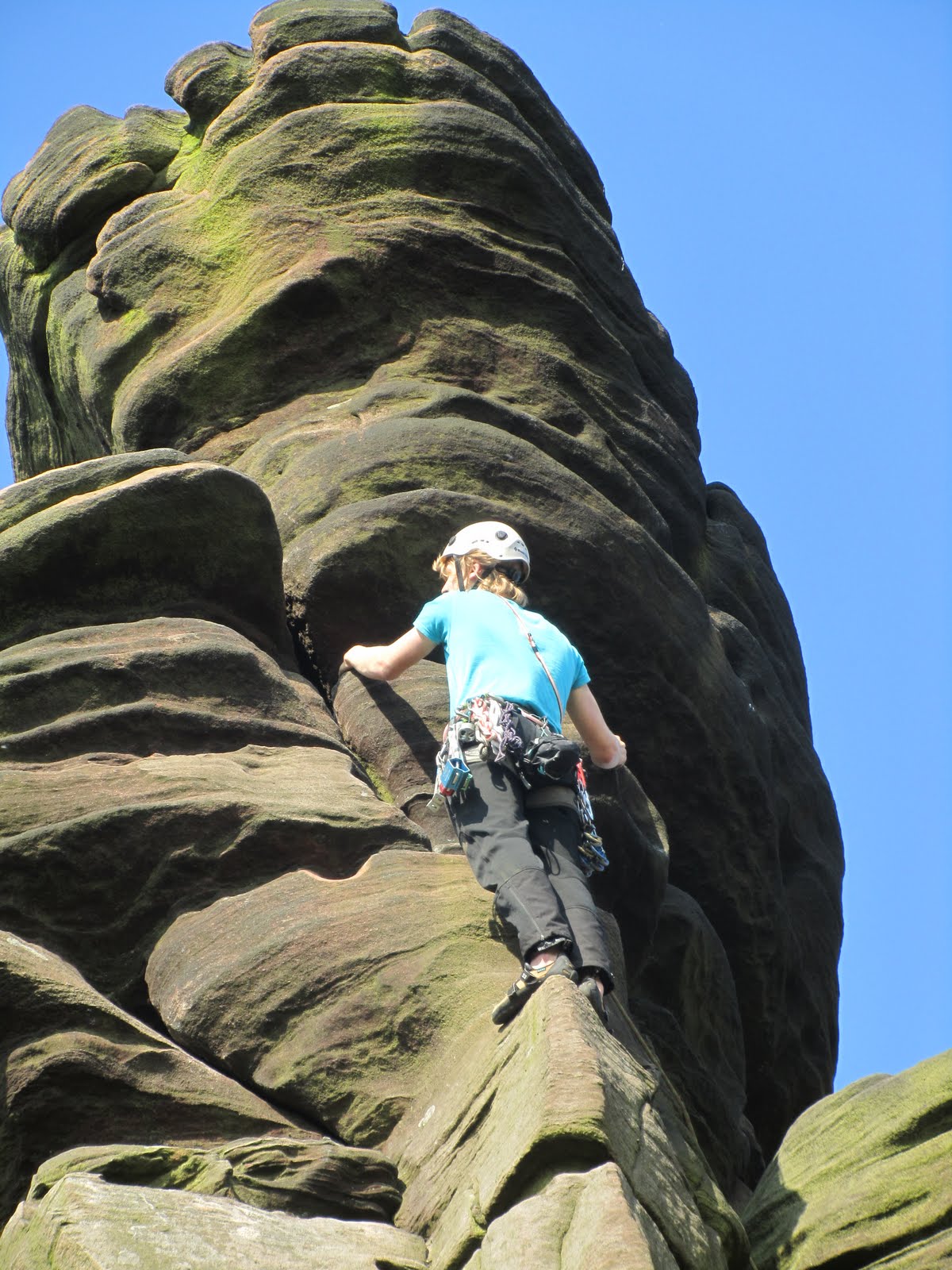
Damascus Crack with the buttress finish

Back to The Roaches, and of course, the reason I was there was that I was once again being taxi; this time to take Ben to join his brother and friends for a spot of climbing.

Damascus Crack is a single pitch climb, graded VS (Very Severe; harder than the bands of Difficult, but less hard than Extreme). The guide book describes the route as 12m, but the alternate, buttress finish adds a bit to that height.

Mark led this one with Ben on belay waiting to second.


Once at the top, Mark set up the belay and it was Ben's turn to climb.


Nicely done :)

Thursday, 28 April 2011

Pastoral scenes and a rather odd signpost

Around the foot of The Roaches are some delightful scenes of agricultural England. How much our countryside would change if it were not for farms and farming!


 This little guy was cautiously curious from the safety of being behind a dry stone wall.


Mum was a bit less certain and called her baby home!


With the combination of pasture, rocks and moorland, it is not surprising that many many people come here to enjoy outdoor activities; walkers and climbers being the predominant groups. The area is criss-crossed with footpaths and access land. Footpath signs tend to show a walker striding out, but I wasn't quite so sure about this one...

Tuesday, 26 April 2011

Roaches peepholes

I really enjoy looking out at the countryside through the little cracks and gaps between the rocks.


Monday, 25 April 2011

Prehistoric monsters in the Staffordshire Peak

It's really noticeable how The Roaches suddenly explode out of the landscape. One minute, the scene is all pastoral; green fields, trees, sheep, cows... and the next, there they are; these great crags of gritstone rising starkly against the skyline like the scaly hide of some prehistoric monster.


I've posted about The Roaches before, so I won't bore you with lots of repeated information, but I was up there yesterday and the afternoon turned out glorious, so I took loads of photos.

The new growth is so bright that is almost looks artificially green.


The Roaches is made up of two tiers of rock, between which is a small plateau of pine wood.


Looking south, Tittesworth Reservoir can be seen...


...while, to the north is the mass of Wildboarclough and, I think, the small shape of the Cat and Fiddle pub, just visible on the skyline to the right of the photo (though I'm quite prepared to be corrected on that one).


PS: I've been doubly corrected about the pub, once by my dad and also by Louise from Ramblings of a Roachling. The pub is The Mermaid, not the Cat and Fiddle; except it's recently been converted into holiday cottages and so isn't a pub now at all. Thank you both!

Louise also points out that the heather in my last photo is part black and part green. This is where there was a two square mile fire a couple of weeks ago. It is thought to have been started by a cigarette!! (I did hear about the fire at the time, but confess I had forgotten that it was so close to the Roaches.)

Wednesday, 22 December 2010

Longstone Edge


This is Longstone Edge (before the snow), a limestone ridge immediately north of the village of Great Longstone, near Bakewell in Derbyshire. Rising to a height of about 1300 feet and running east-west for around 6km, it offers wonderful views over the Peak District.

The edge is quarried for galena, fluorspar and barytes, which is fine, but also for limestone, which is much more controversial because of the sheer scale of the operation. There has been a long running dispute between the Peak Park Authority and Bleaklow Industries Ltd about the rights to quarrying. The last decision, in March 2009, ruled in favour of the Peak Park Authority, but the legal battles continue.

The objection to large scale quarrying at this particular site is that is is a recognised beauty spot and, as such, should be protected. In this case, I have to agree. The line has to be drawn somewhere!


I love the colours in these photos, picked out by the somewhat selective sunshine.
And this is from the same spot, but in the other direction...


...looking very atmospheric with the light breaking through the storm clouds.


Tuesday, 21 December 2010

Into the light

Sometimes, places can look quite dramatic in Winter light.


I love the way that this country lane appears to be heading straight into the light. It makes me want to hurry to where the road disappears, to see what's over the top!

Saturday, 27 November 2010

Quarries and farming

,

Two of the major industries in rural Derbyshire are quarrying and farming.

Derbyshire is the largest quarrying area in the UK. In the 1990s, it produced 20 million tonnes of stone each year, most of which was limestone. It's amazing the kind of stuff stone is used for. Did you know that, as well as the obvious building uses, stone (of various forms) is used in such things as toothpaste, cosmetics, soap, paint, fertiliser... (The list goes on.)

People often moan about the quarries, saying that they spoil the countryside but, for me, the quarry was part of my growing up. I remember that my cousin, when he was a student, worked for a while in the local quarry. He would come home at the end of each shift, covered from top to toe in grey lime dust. When I stayed with my 'Nanna on the Hill' and Grandad, the warning siren used to sound to signal the beginning of blasting at that same quarry. Wagons full of stone would trundle through the country lanes at regular intervals, many owned and driven by local men. Plus, for many years, my 'Nanna with the Hat' was a cook in the canteen there, even after that grandad was killed in an accident while setting the explosives for blasting out the rock. The quarry was part of everyday life in the village and everyone accepted it as such.

Although it may be true that quarries can be an eyesore, they are part of the lifeblood of the rural community, bringing work and money into the area. At the end of the day, the locals can't live on fresh air; there has to be work of some kind and a quarry is a good deal better than a lot of the alternatives!


Farming, of course, is what everyone pictures when talking about the countryside, and it is true that there is plenty of that about too; though not so much as there used to be. In the Peak District, the main types of farming are dairy, beef and sheep; the altitude being a little high for arable crops which need the deeper soils of the lowlands. I love to see the fields, divided up by lines of drystone walls and dotted with cows or sheep. Beautiful.

Friday, 26 November 2010

Above Stoney Middleton


Just along the valley from Calver is Stoney Middleton. We drove up the steep hill past the tiny primary school (one of the smallest in Derbyshire with less than 30 children spread between the ages of 5 and 11) and onto the tops.

The views were spectacular and the sense of space, liberating.


It was so very Derbyshire; dry stone walls, a tumbledown barn, fields, sheep, woodland and edges - rolling hills with moorland. Wonderful!

Wednesday, 24 November 2010

The Roaches


The Roaches is a gritstone escarpment, situated in the Staffordshire Moorlands and rising to a height of 1,657 feet. The name comes from the French les roches, meaning the rocks, and the ridge marks the south-western edge of the Dark Peak area of the Peak District National Park.

The whole ridge, along with other gritstone formations across the Peak, is the result of prehistoric river deltas which laid down sand and grit over the limestone sea bed. Eventually, these became covered over with mud and coal and then compressed over millions of years to form the harder gritstone rock. With the moving of the tectonic plates, England was pushed up out of this sea and erosion did the rest, leaving exposed edges and outcrops of the harder millstone grit.

At the end of The Roaches, separated by a col, is Hen Cloud, which rises steeply above the surrounding land, making a particularly dramatic statement and revealing the layering from when the first rocks were formed, around 300 million years ago.


The Roaches provide some of the best gritstone climbing in the country, which explains why, during reading week, eldest son Mark and a group of fellow climbers came all of the way here from Cumbria; though I did splutter down the phone a bit when he told me that, having just gone all the way up to the Lakes for uni, he was trekking back to home turf to climb! 


Besides, it gave him the opportunity to spend a couple of days at home after they'd done :)

At The Roaches stayed in Rock Cottage, a tiny house built originally as a gamekeeper's home and now converted into a climbing hut, owned by the British Mountaineering Council. It is just visible behind Mark, up through the trees on the edge of the photo.

And, looking the other way, is Tittesworth Reservoir, constructed between 1959 and 1963, to supply water for Leek and Stoke on Trent.
.


Incidentally, if anyone has a few spare millions lying around, The Roaches are up for sale. Currently the whole Roaches Estate is owned by the Peak National Park, but it is not normal practice for Park Authorities to own land, so they are looking for a buyer. It'd just better be someone who wants to care for the area, not exploit it!

Tuesday, 26 January 2010

Benefitting from Beeching? : 'How the Trail Became'

The Peak District National Park (incidentally, the oldest in the world!) is divided into two distinct regions. The White Peak has a limestone base and is characterised by it's rivers, dales and rocky outcrops. Further north, the grit stone based Dark Peak is a land of wild moorlands and wide open spaces.

Traversing the White Peak, the Cromford and High Peak Railway was opened in 1831 as a link between the Cromford Canal at High Peak Junction and the Peak Forest Canal at Whaley Bridge. At the time it was a feat of engineering, being one of the first long distance routes (33 miles) and climbing to a height of 1,266 feet. In comparison, the highest working railway summit today is Ais Gill on the Settle-Carlisle line at 1,169 feet. C&HPR was built as an alternative to a canal and served to carry coal, stone and eventually cotton.
In 1899, it was joined by a second line, the Tissington Railway, which ran from Parsley Hay, 13 miles south to the market town of Ashbourne; from where there was a link to the main line at Rocester. At one time, milk from Derbyshire farms was transported down the Tissington line, onto the main rail network and from there to Finsbury Park in London.
Unfortunately, neither of these lines survived the Beeching axe, closing in stages through the 1960s. In 1971, however, the lines were given a new lease of life, being re-opened - in a joint venture between the Peak Park Planning Board and Derbyshire County Council - as trails for walkers, cyclists and horses. And so 'became' the Tissington and High Peak Trails.
Last May, I had the pleasure of walking a section of the Tissington Trail with a class of Y3 children. It rained (no surprise there then) and the back stragglers complained more and more with every step (awww! - we did a whole 3 miles!), but we had a great time, found loads of evidence of the trails original usage and, because it was a weekday, didn't even have to dodge many cyclists.


Almost the last section of our walk took us down the dip where once stood the Seven Arches. Sadly, the viaduct was demolished, but at least the new path took us right down to the level of the brook and the wooden bridge which crosses it.