Showing posts with label Sheffield. Show all posts

Wednesday, 19 January 2011

A grand day out in Sheffield 12 - Trams by the Cathedral


Sheffield has its own Supertram! It became the second UK city to open a modern tram system; the first being the Manchester Metro, which pre-dates Sheffield by two years.

Opened on 21st March 1994, the Supertram has three routes which run like spokes from the city centre and total 18 miles in length. One spoke stretches north-west to Middlewood, one north-east to the Meadowhall shopping centre and the final one, south east to the interestingly named Halfway. Extensions are planned, including to Rotherham.


One of the stops on the south east line is outside the Anglican Cathedral, the oldest building in Sheffield. There has been a church on this site for over 1000 years, but over the centuries, it has been rebuilt, extended and developed into the modern building. All that remains of the earliest church is a Saxon cross, which is now displayed in the British Museum in London. In the east wall, there are stones dating back to the time of William the Conqueror and a window in the Cathedral Chapter House illustrates Chaucer's reference to Sheffield cutlery in his Canterbury Tale ' The Reeve's Tale' (1300s).

More demolitions, alterations, rebuilding and extensions followed through the centuries until 1914, when the church was granted Cathedral status as a result of the formation of the Diocese of Sheffield. With the ending of the first World War the building underwent a major upgrade, with the aspect of the church being turned through 90 degrees and a second tower and spire being built along with a new chancel and sanctuary.

Although not quite in the same league as places like Wells, Ely or Salisbury, it is nevertheless an impressive piece of architecture! Unfortunately, when we were there, the doors were locked and only the faint glimmer of a security light could be seen shining through the long, high windows. It would have been good to have walked inside.

Monday, 17 January 2011

A grand day out in Sheffield 10 - Town Hall


In 1886, Sheffield Municipal Council launched a competition to select an architect for the design of a town hall. They had 178 responses, from which was chosen that of Mr E. W. Mountford. Building began and the completed construction was officially opened eleven years later on 21st May 1897 by HM Queen Victoria.

The Town Hall is still used by Sheffield City Council but also boasts an impressive array of silverware, which is open to public viewing in the Reception Suite. The outside of the building, which is made of 'Stoke Quarry' stone from Grindleford in Derbyshire, has a range of carvings, designed by Frederick William Pomeroy (1856–1924), a sculptor well known for his work on municipal buildings. The carvings represent scenes from the industries in Sheffield.

Crowned the building is the 2.13m tall statue of Vulcan, atop the 64m high clock tower.


Vulcan also appears, alongside Thor, on the city coat of arms, which was first awarded to the Borough Council on 16th July 1875 and subsequently passed on to the newly formed City Council on 1st September 1977. The choice of these two gods of fire and thunder was deemed appropriate for a city founded on steel working.

Vulcan himself is from Roman mythology and was associated with the use of fire in metalworking as well as having an obvious link to volcanoes. The Romans feared him for the destructive nature of fire and most worship was aimed at averting his anger. He is carved here holding the metalworkers hammer and has, apparently, been adopted as the patron god of Sheffield.

I did wonder if Vulcan might be a little chilly in the weak December sunshine, but, by the afternoon, he had wrapped himself up in a blanket of fog.

Sunday, 16 January 2011

A grand day out in Sheffield 9 - The chances of anything...

... coming from Mars
Are a million to one,
But still
They come!


Do you remember 'War of the Worlds'?

I still prefer the original film. I also prefer the original Jeff Wayne musical!

Saturday, 15 January 2011

A grand day out in Sheffield 8 - Water features

These kinetic water features in the Winter gardens added a nice touch of interest. The power of the water is used to make the feature move. In the case of this top one, the water is trapped in the sectioned channel around the rim of the skeleton globe. When one side is filled, the weight of the water pushes the globe into a downward spiral so that it slowly rotates round the rim.


Here, the leaves work in opposite pairs, like a see-saw. Water is captured on one leaf until it drops and releases a splash. The weight of the opposite leaf then pulls it back up to horizontal for refilling.


Predictably, both pools of water had been used as wishing wells, with a thin layer of small change spread across the bottom of each. I didn't see any notices, but I expect it is all gathered up and donated to charity.

Friday, 14 January 2011

A grand day out in Sheffield 7 - Winter Gardens

Sheffield Winter Gardens is one of the largest temperate glass houses to be built in the UK over the last one hundred years and, at 70 metres long, 22 metres wide and 21 metres high, currently stands as the largest urban glass house in Europe. According to the City website, during the construction of the Winter Gardens, 2,100 square metres of glass, 900 cubic metres of concrete and 80 tonnes of steel were used.


Built as part of the £120 million Heart of the City regeneration project, it was designed by architects Pringle, Richards, Sharratt and consultant engineers Buro Happold and is a 'glulam' design. Glulam is a method by which strips of timber (in this case, larch) are shaped and glued together.


And, under that superb glass roof, the Winter gardens contain more than 2.500 plants from around the globe.


But, enough of the facts and figures. I liked this place. I loved the airy feel of being in a glass house; especially under a bright blue sky. I also loved wandering among the plants, hearing the sound of water and the echo of voices. It's a wonderful oasis in the heart of the city.


Thursday, 13 January 2011

A grand day out in Sheffield 6 - Nine steel balls

Outside the Winter Gardens is Millennium Square, a triangular open public space which was designed by architects Allies and Morrison as part of Sheffield's 'Heart of the City' project.  Within the 'square' is another piece of sculptural artwork, in the shape of these stainless steel spheres. Look carefully into the reflection and you can see that there are more than just the two; balls reflect in balls, reflect in balls, and actually, there are nine in total.


Created by sculptor Colin Rose, winner of the 2003 competition to create a piece of artwork for this location, the nine stainless steel spheres are designed to represent raindrops which have just landed on the surface of the square. They vary in size, the largest being two metres in diameter, and are clustered in groups scattered across the granite paving.

When the weather is not so cold, these balls are water features, their surfaces shimmering with the flow of the running water. At night, they are lit up by coloured LED lights.
(I can see yet another reason for a return trip here! This city has much more to offer than I have yet seen!)


Of course, the use of stainless steel is a celebration of the industry which made Sheffield famous across the globe, but the shape distorts the reflections, reminding me of the old fashioned Hall of Mirrors in a fairground attraction. Look carefully into this last sphere and you can make out the squashed idiot with the camera, accompanied by the friend who now appears to have an extremely eloooooongated neck!


I'm linking up with the marvellous Jenny Matlock and Alphabe-Thursday, which this week, has reached the letter 'n'.

Wednesday, 12 January 2011

A grand day out in Sheffield 5 - Barking up the Right Tree


Moving on upstairs, we found 'Forkocactus Spoonelliflora' and 'Barking up the Right Tree', two sculptures by artist Johnny White, who describes himself as a Mechanical Sculptor, working mostly in steel and usually including kinetic elements or light.

'Forkocactus Spoonelliflora' (the smaller one at the front) is a musical donation box. As the coin is dropped into the sculpture through one of the many slots, it hits a section of the 'musical instrument' within and chimes a note. It was commissioned in 2008 and based on a cactus from the nearby Winter Gardens. Like Barking up the Right Tree, it uses cutlery in its design.

The 'Right Tree'  up which we are meant to bark, is the rather larger giraffe-like, sunflower thingy behind and is entirely covered in knives, forks and spoons; all of which were donated by the people of Sheffield.


This one is the older, having been commissioned in 2000, for the opening of the Millennium Gallery.It was originally intended to be a temporary installation (6 months), but has remained popular and therefore, remained here. 

There are four buttons on a front panel of the tree, three of which activate the heads at the end of the branches and the fourth of which operates an audio clip of a dog barking. (Having said that, we pushed all four and didn't notice any movement from anywhere. It did, however, bark!)


I do find the giraffe face rather appealing! I'm not sure whether it's the sticky-out ears, the curly eyelashes or the thick slobbery lips, but something.

Incidentally, according to the information in the gallery, Johnny White is a local artist, but an arts website I browsed said he is based in Wirksworth. He's certainly been involved in some projects in the Derwent Valley Heritage Area, but I can't find any more info on his location. Anyone shed any light?

Tuesday, 11 January 2011

A grand day out in Sheffield 4 - Bells

Above the Hallam University building is the Millennium Gallery, inside which is this display of bells made in 1866 by Naylor Vickers and Company of Sheffield.


According to the information board, between 1859 and 1890, Naylor Vickers cast over 7,000 bells for churches in the UK and abroad. Mostly, they were intended to be temporary; to be replaced by bronze bells as funds allowed. Because of this very few Naylor Vickers bells now remain. There are only known to be 15 sets around the world.


This ring of bells was originally cast for the Parish Church of Bassaleg, near Newport in South Wales.

Monday, 10 January 2011

A grand day out in Sheffield 3 - Hallam

Just above the station, is Sheffield Hallam University and scribed on the end of one of their tallest buildings, half way up Howard Street, is this poem by former Poet Laureate, Andrew Motion.


Written specifically for this location, it is part of the 2007 'Off The Shelf' literature festival; Sheffield's annual celebration of Reading and Writing - one of the UK's biggest and most significant festivals of the written word, which offers a full and wide-ranging programme for all ages.


Andrew Motion was Poet Laureate between 1999 and 2009 and was awarded an honorary Doctorate at Hallam University in 2002. He became SIR Andrew Motion when he was knighted for services to literature in 2009.

This isn't the only poem displayed around the city, but it's the only one for which I have a photo. One day soonish, I must return and seek out the rest!
Sir Andrew Motion's brief was to write a poem which would grab the attention of the visitor to the city. What do you think? Did he succeed? Does it make sense?


Sunday, 9 January 2011

A grand day out in Sheffield 2 - Reflections


This Wyvern roundel sitting on the Edwardian stone facade of Sheffield Railway Station is a quiet reminder that this was once the Sheffield Midland Railway Station.

A legendary winged reptile with the head of a dragon, the hindquarters of a snake, two legs (or none), and a barbed tail, the Wyvern was the emblem of the rulers of Mercia and happened to be used as an emblem by the Midland Railway company, which operated from 1844 to 1922 and had its headquarters in Derby. That might also explain why one of Derby's retail parks is named The Wyvern; especially as it is nearby where the extensive network of railway sidings used to be.

Initially, Midland Railway (MR) connected Leeds to London St Pancras via Sheffield, but it grew to include connections to Birmingham, Bristol, York and Manchester, eventually, becoming the third largest railway company in the UK. Although the company is long gone, the Wyvern remains to mark MR territory.

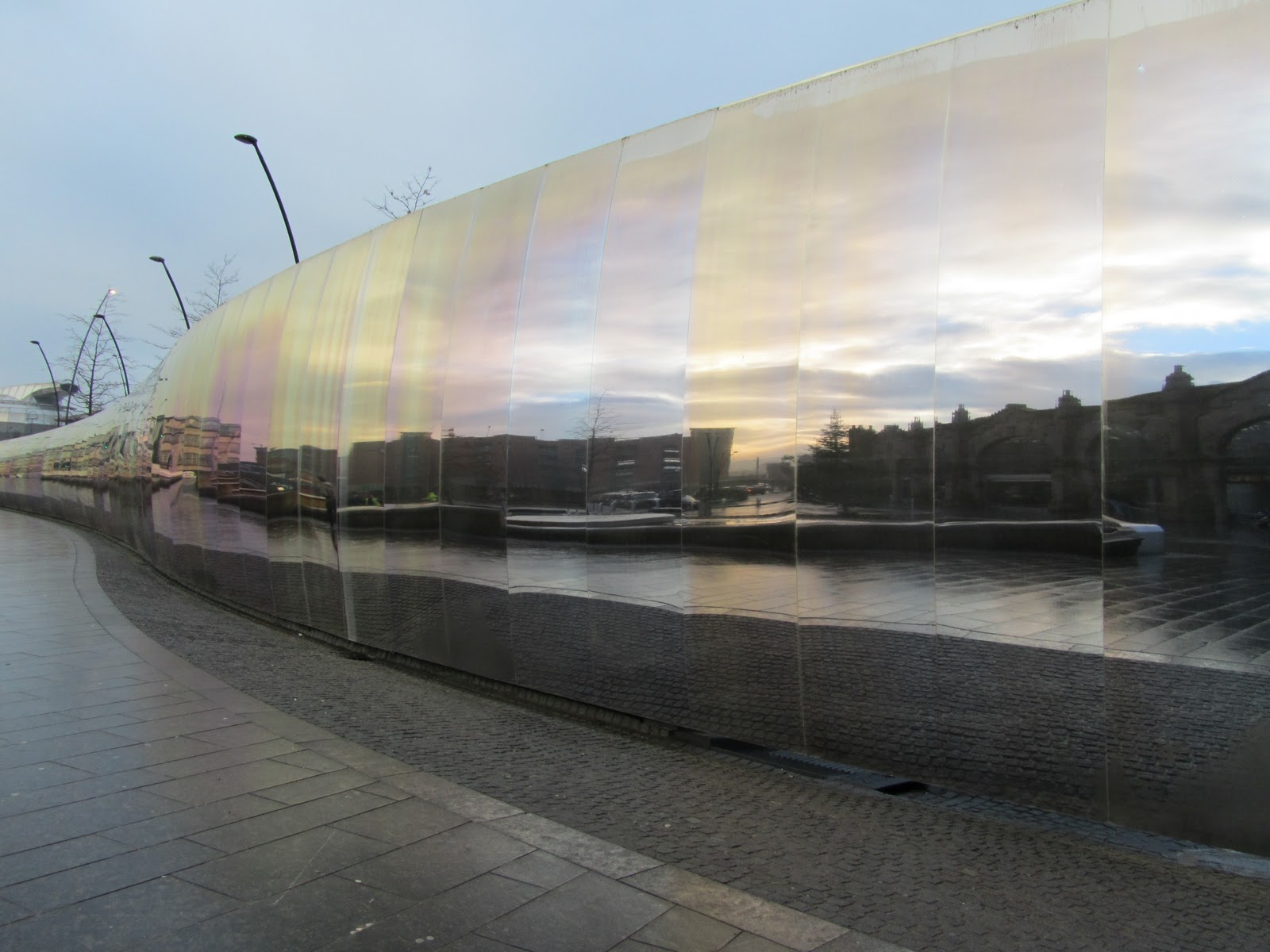
Outside the station is Sheaf Square, a municipal area which underwent significant redevelopment during 2006, opening on 22nd December with a street performance and fireworks. One of the features of the square is the Cutting Edge Sculpture, which combines Sheffield steel with water and light to create a stunning introduction to the city for rail travellers.


Some facts about the sculpture:

  • Sheffield design team, Si Applied and international glass artist Keiko Mukaide collaborated in the development of the sculpture.
  • The sculpture is 90 metres long, and 5 metres high at the highest point.
  • The stainless steel was provided by Outokumpu of Brightside Sheffield, and the structure was manufactured by Jordans of Bristol.
  • The external material is 4mm thick, with a mirror polish on one side of the sculpture and a matt/ satin finish on the other.
  • The sculpture was constructed in eight pieces over a six month period, it was delivered to the site in four deliveries.
  • The materials required to make the external structure weigh approximately 29 tonnes, and the internal frame probably weighs as much. Therefore the whole sculpture weighs approximately 60 tonnes!

If you look carefully, you can see the multi-arched Edwardian facade of the Railway Station, reflected in the mirrored surface.

Tuesday, 4 January 2011

Calling "Time" on Christmas

Tradition says that all Christmas decorations should be down by 12th night, which is, I believe, Thursady, so I thought I would squeeze in two last posts of the Christmas decorations I have spotted on my wanderings - before it was too late.

Starting  in Sheffield, this is the Christmas tree in the Winter Gardens, by day...


and by dark.


Then there is the rather unusual 'tree' outside the Winter Gardens,


the bright white offerings outside the Anglican Cathedral


and the more traditional one outside the impressive Town Hall. 


We also spotted these...


and these.


 Tomorrow, I'll show you a small selection of offerings from parts of East London, but in the meantime I'm wondering, which of the Sheffield decorations do you favour? And are there any which you thoroughly dislike?


Sunday, 28 March 2010

Following the course

Isn't it interesting, the way the same small stretch of river can look so different depending on the direction from which it is viewed?

Standing on the footbridge, this is the view looking north west:


But, personally, I much prefer the view to the south east...


...with the sunlight shining through the still-bare branches and reflecting off the surface of the seemingly still water.

Whichever way it is viewed, this is the fledgling river Don, which rises as a series of small rivers in the Pennines, around Grains Moss, on the borders of Yorkshire and Derbyshire. These converge to form the source of the Don proper, which almost immediately feeds into Winscar reservoir; one of Yorkshire Water's larger reservoirs situated near Dunford Bridge.

From here, the Don winds it's way east through Penistone, and then in a southward loop under the bridge where we were stood and on to Sheffield and Rotherham. Leaving the conurbation, it turns north-eastwards towards Doncaster (not surprising considering the name) before finally mingling its waters with the Yorkshire Ouse at Goole. Originally, the Don was a tributary of the Trent (which also joins the Ouse, 10 miles further downstream) but in 1627 it's route was changed by the Dutch engineer Cornelius Vermuyden, for the purpose of making it navigable for coal barges. Although navigable rivers have largely been superseded by railways and motorways, the Don can still be travelled from Goole as far as Sheffield.

In total, the course of the Don is 70 miles, making it 20 miles longer than Derby's River Derwent which also rises within a few miles of Winscar Reservoir, but on the more southerly slopes of the Pennines.

I find it interesting that the two rivers rise so close together and both end up in the North Sea via the Humber, yet follow such different courses during their 'lives'. I'm sure that there is an analogy there somewhere.