Showing posts with label cumbria. Show all posts

Saturday, 19 November 2011

Lakeland Longings 4 - Ennerdale

Just lately, I've been browsing Facebook photos of Mark up in the Lakes and having to work hard to suppress feelings of insane jealousy, so I thought I'd look back at my last Lake District holiday and make you feel jealous too. After all, a jealousy shared is a jealousy halved. Yes?


Ennerdale Water is the most westerly of the Cumbrian Lakes and also one of the most remote. It is a small glacial lake with a length of 2.5 miles, width of 0.75miles and a depth of 148 feet, slightly deeper than it would naturally be due to the construction of a weir which has raised the level to enable Ennerdale Water to be used as a reservoir for the nearby town of Whitehaven.

The walk around the lake is a very enjoyable 9 miles!


This photo is roughly half way, looking back up to the western end. 


... and this final one is from part way up Angler's Crag, the small but distinctive bump, which can be seen on the right of the first photo and on the left of the second.

I think I'm right in saying that the mountain beyond the end of the lake is Pillar, which lies between Ennerdale and Wasdale.

Tuesday, 15 November 2011

Lakeland longings 2 - Derwent Water

Just lately, I've been browsing Facebook photos of Mark up in the Lakes and having to work hard to suppress feelings of insane jealousy, so I thought I'd look back at my last Lake District holiday and make you feel jealous too. After all, a jealousy shared is a jealousy halved. Yes?


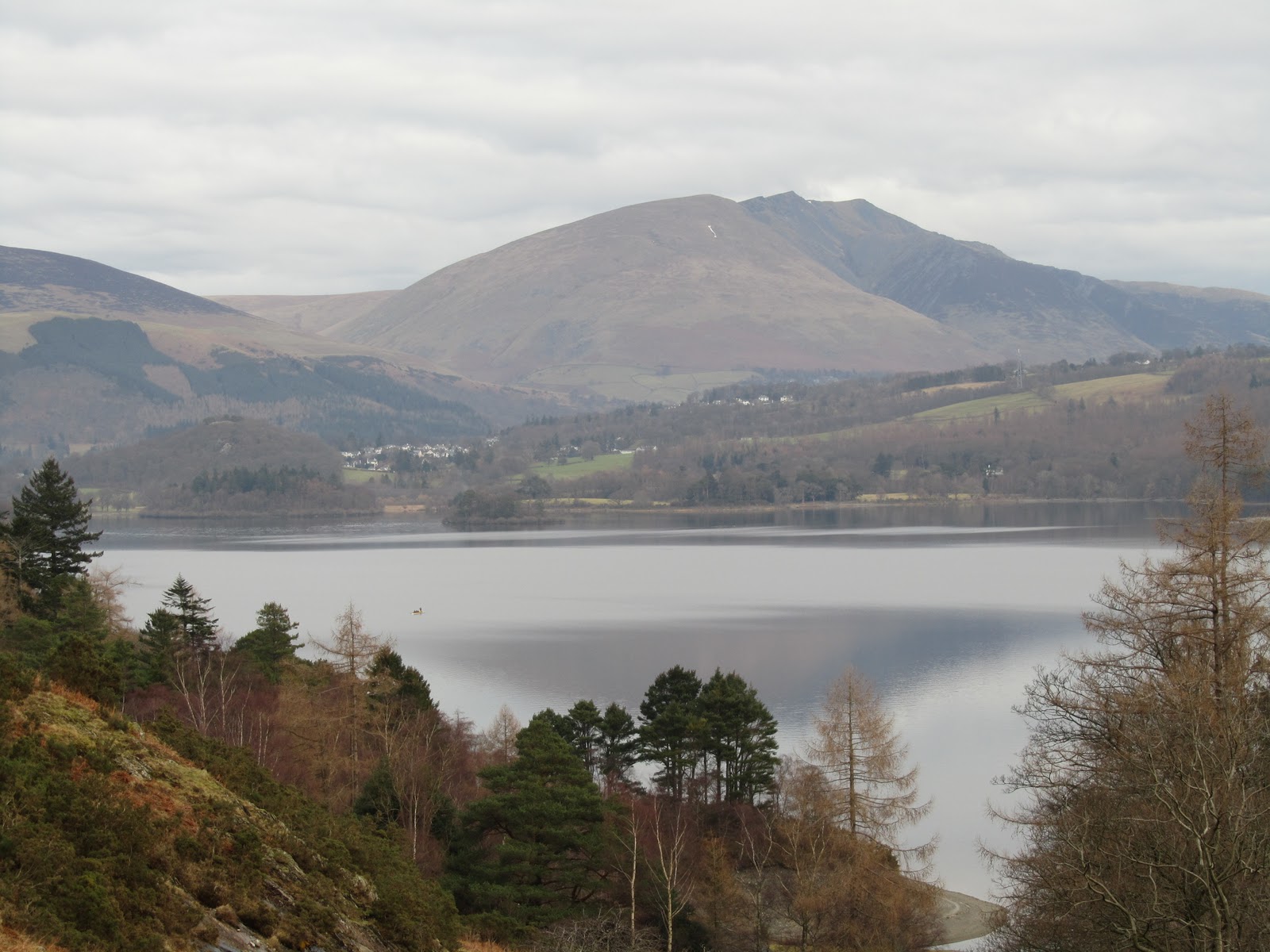
Derwent Water is one of the best known of the English Lakes and very popular with tourists. It is 3 miles long, 1 mile wide and 72 feet deep, much smaller than Wastwater.


Like Windermere, Ullswater and Coniston, it has a cruise boat company which operates a service around the lake; the full trip taking around 50 minutes and stopping at such places as Lodore with it's waterfall, subject of the 1820 peom by Robert Southey. This is just an extract:

From its sources which well
In the tarn on the fell;
From its fountains
In the mountains,
Its rills and its gills;
Through moss and through brake,
It runs and it creeps
For a while, till it sleeps
In its own little lake.
And thence at departing,
Awakening and starting,
It runs through the reeds,
And away it proceeds,
Through meadow and glade,
In sun and in shade,
And through the wood-shelter,
Among crags in its flurry,
Helter-skelter,
Hurry-skurry.
Here it comes sparkling,
And there it lies darkling;
Now smoking and frothing
Its tumult and wrath in,
Till, in this rapid race
On which it is bent,
It reaches the place
Of its steep descent.

If you'd like to read the whole poem, including the actual descent, click here.


The closest town to Derwent Water is Keswick, above which towers the 3,054 feet high mountain of Skiddaw, fourth highest in the UK. But perhaps the most distinctive of the fells along Derwent Water is Cat Bells (below). Although a mere 1,480 feet, it is easily recognisable by its shape and is very popular with walkers because of the views it offers.


Monday, 14 November 2011

Lakeland longings 1 - Wastwater

Just lately, I've been browsing Facebook photos of Mark up in the Lakes and having to work hard to suppress feelings of insane jealousy, so I thought I'd look back at my last Lake District holiday and make you feel jealous too. After all, a jealousy shared is a jealousy halved. Yes?

This is one of my favourite lakes; Wastwater.


Really. It is! It's there. Keep looking...

See!


The footpath follows the river in, turns a corner and gives wonderful views up the lake.

Wastwater, sitting in the Wasdale valley, is 3 miles long, half a mile wide and 260 feet deep; the deepest of all the Lake District lakes. It's made very easy to identify by the scree slopes all along the eastern shore. At the northern end is Wasdale head, over which towers the pyramid of Great Gable (visible in the photo) and the rugged bulk of Scafell Pike (tucked round the corner); the latter being the highest mountain in England at 978m (3,210 feet). Above the western shore, looking a little like a sleeping lizard, is Yewbarrow, to the left of which is Red Pike. The other mountain in the photo is Kirk Fell

I've climbed four of the five. Scafell Pike was a bit of a disappointment. In fairness, we did climb in on a May Bank Holiday Monday, but the top was packed with people and also rather litter strewn. You would think that, having made the effort to sweat all of the way to the top, people would have taken their rubbish home!

Great Gable was completely different! It was a beautiful late spring day, the view down Wastwater was spectacular and it was like being on top of the world!

Yewbarrow and Red Pike form part of the Mosedale Horseshoe, but we just did the pair, beginning with Yewbarrow and then dropping down into the col before up Red Pike. Yewbarrow was a lovely walk, with a lot of scrambling and great views down both side of the edge as we approached the top. Anyone with a dislike of heights or edges would not be happy, but I loved it.

The highlight of the walk was the very sudden, and extremely loud, passing of an RAF fighter jet, which followed the line of the lake.

What was so special about that?

It was flying below us!  :)

Sunday, 17 April 2011

Ullswater


This is Ullswater on a slightly more sunny day than last time I visited.


Saturday, 16 April 2011

Skiddaw


To the best of my knowledge, the first time I ever visited the Lake District was when I was about 11 years old. Up until that time, most of our summer holidays had been in my mum's friend's caravan which was by the sea in Norfolk. Norfolk is flat!

As I recall, I was going on a school residential in the Lakes, from Monday to Friday, but my family went up there a couple of days early because my parents were taking the opportunity for a holiday while I was away and had hired a little Volkswagon Dormobile.

We camped in a caravan park in Keswick and I remember quite clearly, standing beside this dormobile and being totally intimidated by the size of the mountains. I felt extremely small and a little afraid. Isn't it funny how some memories stick?

As an adult, every time I have visited Keswick, I have looked up at the fells and wondered how they could have instilled such fear, but maybe it is not such a bad thing. These may not be in the same league as the Alps or the Rockies or the Himalayas, but get lost up here in the fog or the dark and these fells can still kill. They should always be treated with respect.

.

The dominant mountain around Keswick is Skiddaw. Standing at 3,054' (931m), Skiddaw is ranked number four in height in England. The fell is pretty much conical and comprised of slate. It boasts a series of peaks along its top of which High Man is the actual summit.


Because of its shape, it is considered one of the best fells for a beginner walker wanting to attempt a mountain. Ironically, it's one of the fells which I haven't climbed. I gather that, on a clear day, the view from the summit is impressive; sometimes even stretching as far as the Mourne Mountains in Northern Ireland (120 miles away).

Friday, 15 April 2011

Passageway


I rather liked this narrow passageway leading away from Keswick market place and opening up to the distant fell view.

Monday, 7 February 2011

Around Derwentwater 10 - Keswick by Night


A pretty market town in the North Lakes, Keswick is a major centre for tourists in the area and tends to be very busy during the summer months. Indeed, tourism has become the main industry in the town, which offers shops, accommodation, eating places, art galleries and a tourist information centre which is housed in the Moot Hall.

Built in 1813, the Moot Hall stands at the top of the market place and, in its time, has been a courthouse, a prison, a museum, the town hall and a fruit market! On the west tower, just visible in my photo, is a clock; unusual because it has only one hand!


Below the Moot Hall is the market place. Keswick was granted its charter to hold a market by Edward I, in 1276 and the Saturday market continues to this day with a selection of stalls setting up from around 6am and continuing through til 4pm. Goods on offer include quality second hand books, a selection of clothes and footwear, jewellery and local produce.

In summertime, the market expands to cater for the growing number of tourists, while on the first Sunday in December, there is always a Christmas fayre. This special event kicks off the festive season in the town and is designed to benefit charities.The fayre is organised by members of the Keswick Lions Club along with the Rotarians and provides stalls for local charities and organisations (such as Scouts and Guides and schools) to raise money for their own good causes.

Alongside the decorated stalls, street entertainers perform, there is a kiddies funfair and Santa comes to sit in his grotto. The whole area in the photo below would be packed with people :)


It's a little more quiet on a Sunday evening in late January!

Sunday, 6 February 2011

Around Derwentwater 9 - Ladder Stile


Way, way back, not long after I first began this blog, I ran a mini series of 4 scattered posts about stiles. I like stiles! I'm not exactly sure why, but they appeal to me as structures. Occasionally, I join with a friend in a walking group and there is one member who is a bit of a purist, insisting on climbing every stile, even when it is positioned next to a wide open gate or an enormous gap in the wall. I can sort of identify with her; though more so at the beginning of the walk when my legs are fresh, than at the end.

It's taken me a while to snap a ladder stile because they are less common than other kinds. All designs of stile set their own peculiar problems when it comes to accessibility, but, for many, the ladder stile is the biggest pain of all. Imagine coaxing a dog over one of these, or lifting a pushchair or bicycle. All possible, but problematic.

As a result, ladder stiles are built as a bit of a last resort; but prove particularly useful where a wall needs to be surmounted. They tend to be more common in upland areas and on moorlands, but this one is at the foot of Shepherd's Crag in Borrowdale.


If you want to check out other stiles, click the label at the bottom of this post.

Around Derwentwater 8 - Blencathra


More of a small range than a single fell, the highest summit of Blencathra stands at 2,848 feet. The name Blencathra probably comes from the Cumbric blaen (a bare hill top) and cathrac (a chair) and sums up this fell quite accurately.

Quite soon after moving up to Cumbria, Mark and one of his friends decided to 'do' Blencathra. To make it more of a challenge, they set themselves the goal of reaching the summit and returning in less than two hours. They were really peeved when it took them 2 hours and 4 minutes!

Personally, I'd be delighted to do it one way in that time, but, once up there, I'd want a long pause to admire the view!

Friday, 4 February 2011

Around Derwentwater 7 - A view from the top

The view from the top of Shepherd's Crag was amazing!

Looking south down Borrowdale towards Rosthwaite.


...North up Derwentwater towards Skiddaw fell.


...and straight down at this footbridge over the river.

Thursday, 3 February 2011

Around Derwentwater 6 - A Question

A question...

How is your head for heights?

After our walk, I took a scramble around the side of Shepherd's Crag in Borrowdale, to join the lads on the top of their climb.


It was a long way up!

I like heights, but my stomach did turn a little queasy as I walked past the edge to reach the top of the route.


I'm told that it's a three pitch climb, which means that it is normally climbed in three stages, with the lead climber stopping at a suitable point to fasten in and set up a belay for the follower. When the follower has climbed up to join the lead, they usually change roles so that they don't have to swap the belay plate between harnesses whilst hanging onto a rock ledge.

The lads hung around on the top for a short while because Mark had a 'Hex' jammed fast into a crack on the rock face and he wanted to abseil down to retrieve it before we left, but, meanwhile, there was another group of climbers coming up.

When, eventually, the route was clear, Ben was on belay duty for the abseil.


Much to his delight, Mark did manage to loosen the Hex and bring it up. As he pointed out, he's a student... he can't afford to leave equipment behind!

There will unquestionably be a quorum of quality Q posts over at Miss Jenny's Alphabe-Thursday. Why not take a quick shufty?

Wednesday, 2 February 2011

Around Derwentwater 5 - A sheep with a view

After navigating the shore, we climbed up to the bridleway which runs along the side of Catbells, turning back south to complete our walk.


There are definitely some things which would be good about being a sheep!


Tuesday, 1 February 2011

Around Derwentwater 4 - Along the east shore

More offerings from along the east shore of Derwentwater.


How wonderful it would be to actually own a boat here and be able to go out onto the lake at will.


This lopsided tree made us smile.

Monday, 31 January 2011

Around Derwentwater 3 - National Trust


The National Trust is a UK charity which is totally independent of government, relying on membership, donations, legacies and commercial activities to generate its income. The purpose of the organisation is to protect and show historic houses, gardens and monuments. In addition to this, they also buy and maintain areas of natural beauty; moorland, forests, fens, coastline, marshes and archaeological sites. The aim is to protect and preserve the historic and natural beauty of our island, for all to enjoy.

Brandlehow, 108 acres of woodland and pastureland at the foot of Catbells, on the east shore of Derwentwater, was the first purchase of the National Trust in 1902. The woods were opened to the public on 16th October, by HRH Princess Louise, daughter of Queen Victoria. As part of the opening ceremony, four oak trees were planted., one by the Princess and the other three by Miss Octavia Hill, Sir Robert Hunter and Canon H D Rawnsley of Crossthwaite, all of whom were instrumental in the founding of the Trust.

The Trust itself was founded just six years earlier in 1896 after some vigorous campaigning. Their first lifelong member was the father of Beatrix Potter, writer of the famous tales about Jemima Puddle Duck, Peter Rabbit and friends.

In 2002 the National Trust celebrated its 100 year anniversary and these carvings were placed at Brandlehow to mark the occasion.


Since its foundation, the National Trust has grown somewhat and now owns or leases around one quarter of The Lake District National Park, ensuring its preservation for generations to come.

Sunday, 30 January 2011

Around Derwentwater 2 - Low Brandlehow


The Keswick Launch Company runs boats around the lake throughout the year, stopping off at seven landing stages, including this one at Low Brandlehow. Boats travel both clockwise and anti-clockwise, with the round trip taking 50 minutes.


Saturday, 29 January 2011

Around Derwentwater 1 - The beginning


Last Sunday, Dad, Ben and I took a day trip to Cumbria to see Mark. Ben took up all of his climbing gear and while they were spending their afternoon hauling themselves up a rock face, Dad and I went for a rather more sedate walk.

We dropped off the lads in Borrowdale and headed for the east shore of Derwentwater.


Boots on; flask in rucksack; camera over shoulder. What could be better?